Bell Pepper (Sweet Pepper)
|
Major Growing Areas
Originally from Central and South America, bell peppers are now widely grown in places such as China, Mexico, Turkey and Indonesia.
Varieties
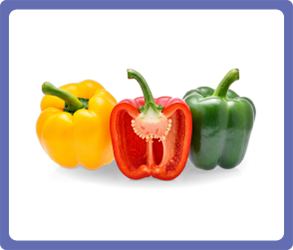
Also known as capsicums or simply peppers, bell peppers belong to the Solanaceae family. In addition to the common red, yellow and green ones, they also come in other colours such as orange, purple and white, all of which are the same variety. The colour of a bell pepper mainly depends on its ripeness. Different stages of ripeness result in slight variations in the nutritional content.
Nutritional Values
Rich in water, vitamin C and various antioxidants, bell peppers help boost immunity. Bell peppers of different colours have their own unique nutritional profiles. For example, red peppers are rich in β-carotene, while yellow and green peppers provide flavonoids and chlorophyll, respectively. These phytochemicals all have antioxidant properties, aiding in promoting cell health and preventing diseases.
|
| Per 100 g (of red peppers) |
| Energy |
26 kcal |
| Dietary Fibre |
2.1 g |
| Vitamin C |
128 mg |
| Vitamin A |
157 µg |
| β-carotene |
1620 µg |
| Potassium |
211 mg |
Buying and Cooking Tips
The best bell peppers should have unwilted stems, with an even, intact and plump appearance, and a bright, glossy colour. Bell peppers are among the most colourful vegetables, offering vivid hues, a crisp texture, and a mild, sweet flavour. They can be prepared in various ways: eaten raw in salads, or stir-fried, baked, pan-fried, roasted and even stuffed.
Fun Facts
Bell peppers and chili peppers actually come from the same family, with the main difference lying in their capsaicin content. Chili peppers have more capsaicin, which gives them that intense, fiery kick. Bell peppers, on the other hand, have very little capsaicin, so they are hardly spicy at all and taste mild and sweet. Bell peppers are short, plump and round in shape, much like a bell, and that is how they got their name (Note: Bell peppers are literally called “lantern peppers” in Chinese, as their shape resembles that of a Chinese lantern). The common green, yellow and red peppers are the same variety. The green pepper is the fruit harvested earlier. As the fruit ripens and builds up nutrients such as lycopene and flavonoids, the colour changes from green to yellow, then orange, and finally red. For those who wish to obtain a full range of nutrients, they should eat bell peppers of different colours!
Common Dishes:
Stir-fried Pork Slices with Bell Peppers; Stuffed Bell Peppers; Crispy Bell Pepper and Tuna Salad, etc.
"One serving of vegetables" is approximately equivalent to:
½ bowl of cooked bell peppers or one bowl of uncooked sliced bell peppers
Note: One bowl = 250-300 ml
|
|
|
|
|