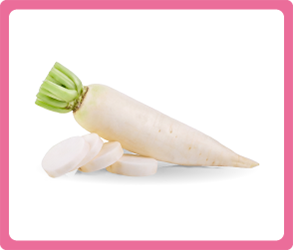
White Radish
|
Major Growing Areas
Originally from East Asia (such as China and Japan) and the Mediterranean region of Europe, white radishes are now widely grown in places such as China, the United States, Russia, Germany and Uzbekistan.
Varieties
Also known as moolis or daikons, white radishes are a member of the radish family. Radishes come in many varieties, including those with white skin and white flesh (white radishes), those with red skin and white flesh (cherry radishes), those with green skin and white flesh (green radishes), those with green skin and red flesh (watermelon radishes), and those with black skin and white flesh (black radishes). Radishes of different types significantly vary in colour, texture and how they are used.
Nutritional Values
White radishes are rich in water, dietary fibre, vitamin C, as well as potassium, which helps maintain stable blood pressure by excreting excess sodium from the body.
|
| Per 100 g (Approximately equivalent to one medium-sized onion) |
| Energy |
18 kcal |
| Carbohydrate |
4.1 g |
| Dietary Fibre |
1.6 g |
| Vitamin C |
22 mg |
| Potassium |
227 mg |
Buying and Cooking Tips
The best white radishes should be straight and feel heavy for their size. The skin should be clean, white and smooth without blemish, and the stems should be firm and vibrant green. A crisp sound when tapped means the white radish is full of moisture. Different parts of the white radish vary in sweetness: the end near the leaves is sweeter and great for eating raw or in salad; the middle is softer and works well in soup; the very tip is pungent and spicy, ideal for pickling or making purée. White radishes can be prepared in many ways – enjoyed raw in salad, pickled, braised, stewed, boiled, stir-fried or simmered slowly in soup.
Fun Facts
Although carrots are also called “radishes” in Chinese, they belong to the carrot family and have no connection with white radishes. The two completely differ in terms of nutritional value, taste and texture. White radishes have a natural bitter taste, but we can get rid of it by peeling the outer skin thickly and blanching them in rice-washing water. Adding a bit of sugar when cooking also helps bring out a sweet flavour. The Japanese call white radishes “daikons”, while the Chinese call them “cai tou”, which sounds like the word for “good fortune”. That is why there is a tradition of eating turnip cakes during Chinese New Year, which symbolises rising step by step in career and good luck.
Common Dishes:
Stir-fried Shredded Pork with White Radish and Dried Shrimps; White Radish and Pork Rib Soup; Turnip Cake; Cold White Radish Salad, etc.
"One serving of vegetables" is approximately equivalent to:
½ bowl of cooked white radishes
Note: One bowl = 250-300 ml
|
|
|
|
|