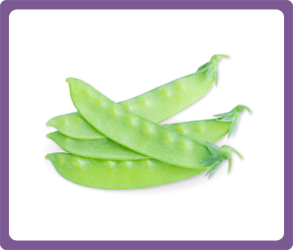
Snow Pea
|
Major Growing Areas
Originally from Europe and North Asia (but not from the Holland), snow peas are now grown in places such as Canada, Russia, China, India, the United States, Australia, France, Ukraine and Japan.
Varieties
Also known as mangetouts or Chinese pea pods, snow peas have thin, flat pods, and both the pods and the peas inside are edible.
Nutritional Values
Snow peas are rich in dietary fibre, potassium, folic acid and vitamin C. Their vitamin A and β-carotene content promote eye health.
|
| Per 100 g |
| Energy |
42 kcal |
| Dietary Fibre |
2.6 g |
| Vitamin A |
1090 IU |
| β-carotene |
630 µg |
| Folic Acid |
42 µg |
| Vitamin C |
60 mg |
| Potassium |
200 mg |
Buying and Cooking Tips
The best snow peas have pods that are flat and bright green, with fine strings, small peas and no obvious bump. As snow peas have thin pods, they lose moisture easily and do not tolerate dryness well. It is therefore advised to store them in the fridge. Snow peas have a crisp texture and a sweet taste, and are great for stir-frying, boiling or braising.
Fun Facts
Snow peas were introduced to China by Dutch merchants through trade, and are therefore literally called “Holland peas” in Chinese. Later, snow peas were crossbred with garden peas for refinement, giving rise to a new variety with thicker pods and a sweeter taste known as “sweet peas”.
Common Dishes:
Stir-fried Prawns with Snow Peas and Garlic; Stir-fried Snow Peas with Fresh Yam and Wood Ear Fungus; Green Curry with Eggplant, Snow Peas and Tofu.
"One serving of vegetables" is approximately equivalent to:
½ bowl of cooked snow peas
Note: One bowl = 250-300 ml
|
|
|
|
|